In the field of chemical synthesis, asymmetric catalysis has long been one of the most challenging research directions. It concerns whether we can efficiently and precisely synthesize molecules with specific chiral structures, which are widely found in pharmaceuticals, pesticides, and functional materials. Electrochemical synthesis, as a green method that uses electricity to drive chemical reactions, has also attracted increasing attention in recent years.
However, when these two powerful technologies are combined, they often prove difficult to integrate. This is particularly true in nickel-catalyzed asymmetric reductive cross-coupling reactions, where conventional direct current methods face two major challenges: cathodic over-reduction and anodic deposition of metal salts. These issues have severely limited further progress in this field.
Recently, the research team led by Associate Professor Chen Zhu at Eastern Institute of Technology, Ningbo achieved a new breakthrough in asymmetric cross-coupling reactions. The team introduced asymmetric waveform alternating current, or asym. AC, into nickel-catalyzed asymmetric reductive cross-coupling reactions for the first time.
The findings were published in the international journal Nature Communications.
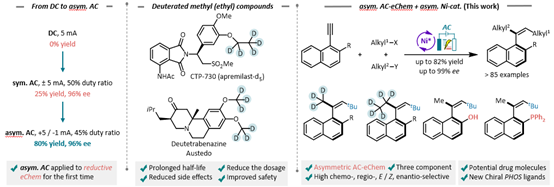
Asymmetric coupling reaction enabled by alternating-current/nickel cooperative catalysis | Image courtesy of the research group
This study developed an asymmetric reductive dialkylation of alkynes based on asymmetric waveform alternating-current/nickel cooperative catalysis, successfully overcoming key challenges in direct-current electrolysis systems, including cathodic over-reduction and anodic deposition of metal salts. Through periodic reversal of electrode polarity, this strategy enables dynamic regulation of the electrochemical interface, thereby efficiently constructing axially chiral aryl alkenes. It also demonstrates excellent substrate scope, functional group compatibility, and potential for continuous-flow scale-up.
In addition, this method can be used for the synthesis of deuterated compounds and novel chiral phosphine ligands. The resulting chiral phosphine ligands exhibit excellent chiral induction ability in palladium-catalyzed asymmetric allylation reactions.
By combining experimental studies with density functional theory (DFT) calculations, the authors systematically revealed the reaction pathway and the origins of chemoselectivity, regioselectivity, E/Z selectivity, and enantioselectivity. This work lays a foundation for extending the asymmetric alternating-current strategy to more transition-metal-catalyzed reductive reactions in the future.
Postdoctoral researcher Zhiyang Lin of Eastern Institute of Technology, Ningbo is the first author of the paper. PhD student Cai Zhai of Eastern Institute of Technology, Ningbo contributed to the DFT calculations and mechanistic studies. Chen Zhu is the sole corresponding author. This research was supported by the National Science and Technology Major Project of the Ministry of Science and Technology, the National Natural Science Foundation of China, and other programs.
Paper information:
https://doi.org/10.1038/s41467-026-72336-5
About Chen Zhu’s Research Group
 Chen Zhu
Associate Professor
The research group mainly focuses on organic photoelectrosynthesis, transition-metal coupling, DFT calculations, machine learning, and chemical automation.
Contact:
chen.zhu@eitech.edu.cn